Top 5 AI Chatbots to Watch in 2026

Fares Elhelali
11 min read
AI chatbots have gone from novelty to core infrastructure. What started as simple conversational tools have evolved into reasoning engines, research assistants, coding partners, and full workflow operators. With the chatbot market projected to surpass $12 billion in 2026, the competition between platforms has never been fiercer.
But not all chatbots are created equal. Some excel at creative writing, others dominate in research, and a few are designed to live entirely inside enterprise ecosystems. Choosing the right one depends on what you actually need it to do.
We took a close look at the most capable AI chatbots available right now, focusing on what makes each one genuinely useful. Here are the five AI chatbots we think matter most in 2026.
1. ChatGPT
OpenAI's ChatGPT remains the most well-rounded AI chatbot on the market. Now powered by the GPT-5 model family (including GPT-5.2 and its reasoning-focused variants), ChatGPT has grown far beyond a simple chat interface into a full productivity platform used by over 800 million people weekly.
What keeps ChatGPT ahead is versatility. It handles everything from casual conversation to complex multi-step tasks like content writing, code generation, data analysis, and research synthesis, all without requiring heavy prompt engineering. The platform also benefits from a mature ecosystem of features that most competitors still lack.
Why ChatGPT Stands Out
- Deep research and web browsing. ChatGPT can search the web, pull from multiple sources, and synthesize findings into structured reports, making it a serious research tool.
- Top-tier code generation. With Codex integration, ChatGPT is significantly ahead of most competitors for programming tasks across multiple languages.
- Built-in image generation. DALL-E integration lets you create and iterate on visuals directly in the conversation.
- Custom GPTs. You can build specialized versions of ChatGPT trained on your own data and instructions for specific use cases.
- Multimodal input. ChatGPT accepts text, images, files, and voice, and can reason across all of them.
- Cost-effective pricing. The full suite of features is available on the Plus plan at $20 per month, with a capable free tier also available.
2. Claude
Anthropic's Claude has quietly become one of the most respected AI chatbots in the industry. Now on the Claude 4.6 model family (including Claude Opus 4.6 and Claude Sonnet 4.6), Claude has earned a reputation for producing some of the highest-quality writing and code of any AI chatbot available.
Where Claude really shines is in the quality and nuance of its output. It consistently produces writing that reads naturally, avoids the generic "AI voice" that plagues other chatbots, and handles complex creative and analytical tasks with a level of care that developers and writers have come to rely on. Claude Code, its command-line coding tool, has also become a go-to for developers who want an AI that can understand and extend entire codebases.
Why Claude Stands Out
- Best-in-class writing quality. For drafting articles, emails, reports, or any long-form content, Claude consistently produces output that sounds human and reads well.
- Strong coding capabilities. Claude Code lets developers delegate coding tasks directly from their terminal, and it can reason about entire repositories.
- Extended context handling. Claude can work with very large documents and maintain coherence across long conversations, making it ideal for complex analysis.
- Balanced safety approach. Claude is known for finding a thoughtful balance between being helpful and being cautious, without being overly restrictive.
- Competitive pricing. Claude offers a generous free tier, with Pro access at $20 per month for heavier usage.
3. Google Gemini
Google Bard is gone. In its place is Google Gemini, a much more capable chatbot built on the Gemini 3 model family (including Gemini 3 Pro, Gemini 3 Flash, and Gemini 3.1 Pro). Gemini has matured into a strong all-rounder with a particular edge in search-grounded accuracy and Google Workspace integration.
What makes Gemini compelling is how deeply it's wired into Google's ecosystem. If your workflow lives in Gmail, Google Docs, Sheets, Drive, or YouTube, Gemini can pull context from those tools and act on it directly. Its real-time access to Google Search also means its responses tend to be grounded in current, verifiable information.
Why Gemini Stands Out
- Deep Google ecosystem integration. Gemini connects natively with Gmail, Docs, Sheets, Drive, YouTube, and Google Search, making it the natural choice for teams already in Google Workspace.
- Search-grounded accuracy. By blending its language model with live Google Search data, Gemini produces responses that are more factually grounded and less prone to hallucination.
- Strong reasoning and coding. The Gemini 3 Pro model delivers strong performance across reasoning, math, and code generation tasks.
- Multimodal capabilities. Gemini handles text, images, audio, and video inputs, with particularly strong performance on visual reasoning tasks.
- Accessible pricing. A free tier is available with basic features, and paid plans unlock advanced model access and higher usage limits.
4. Microsoft Copilot
Microsoft Copilot has evolved well beyond its origins as "Bing Chat." Now powered by GPT-5.2 and deeply embedded into the Microsoft 365 suite, Copilot has become the AI assistant for enterprise productivity. It operates across Word, Excel, PowerPoint, Outlook, Teams, and SharePoint, making it less of a standalone chatbot and more of an AI layer that sits on top of your entire work environment.
The biggest shift in 2026 is Copilot's move toward agent-style functionality. Rather than just generating one-off responses, Copilot can now make iterative, multi-step edits to documents and spreadsheets while staying transparent about what it changed. For organizations already invested in the Microsoft ecosystem, Copilot is the most seamless way to bring AI into daily workflows.
Why Copilot Stands Out
- Full Microsoft 365 integration. Copilot works natively inside Word, Excel, PowerPoint, Outlook, Teams, and SharePoint, pulling context from across your work environment.
- Agent mode. In Word, Excel, and PowerPoint, Copilot can now work alongside you through multiple editing steps rather than just generating a single draft.
- Enterprise-grade governance. Built-in admin controls, data protection through Microsoft Purview, and detailed usage analytics make Copilot the most enterprise-ready option.
- Meeting intelligence. Copilot in Teams can summarize meetings, generate action items, and even create video recap highlights.
- Powered by GPT-5.2. Users can choose between quick responses and deeper reasoning modes depending on the complexity of their task.
5. Perplexity AI
Perplexity AI occupies a unique space in the chatbot landscape. It's less of a general-purpose assistant and more of an AI-powered research engine. Every response comes with source citations, making it the go-to tool for anyone who needs answers they can actually verify.
Unlike most chatbots that rely on a single underlying model, Perplexity lets users choose from multiple leading language models, giving you flexibility based on your specific task. Its hybrid approach of combining live web search with AI-generated synthesis makes it particularly strong for research, fact-checking, and staying on top of current events.
Why Perplexity Stands Out
- Source citations on every response. Every answer comes with clickable references, so you can verify claims and dig deeper into sources.
- Real-time web search. Perplexity pulls from live internet data to ensure responses reflect the most current information available.
- Multiple AI models. Users can switch between different language models to find the best fit for their specific query.
- Research-first design. The entire interface is built around finding, synthesizing, and presenting information clearly, making it ideal for academic, professional, and investigative research.
- Clean, focused interface. Perplexity avoids feature bloat and stays focused on doing one thing exceptionally well: answering questions with evidence.
Beyond Off-the-Shelf: Build Your Own AI Chatbot with Chatbase
The AI chatbots above offer impressive capabilities out of the box. But they all share a common limitation: you work with what they give you. You can't deeply customize their knowledge base, control how they represent your brand, or deploy them wherever your customers are.
That's where Chatbase comes in.
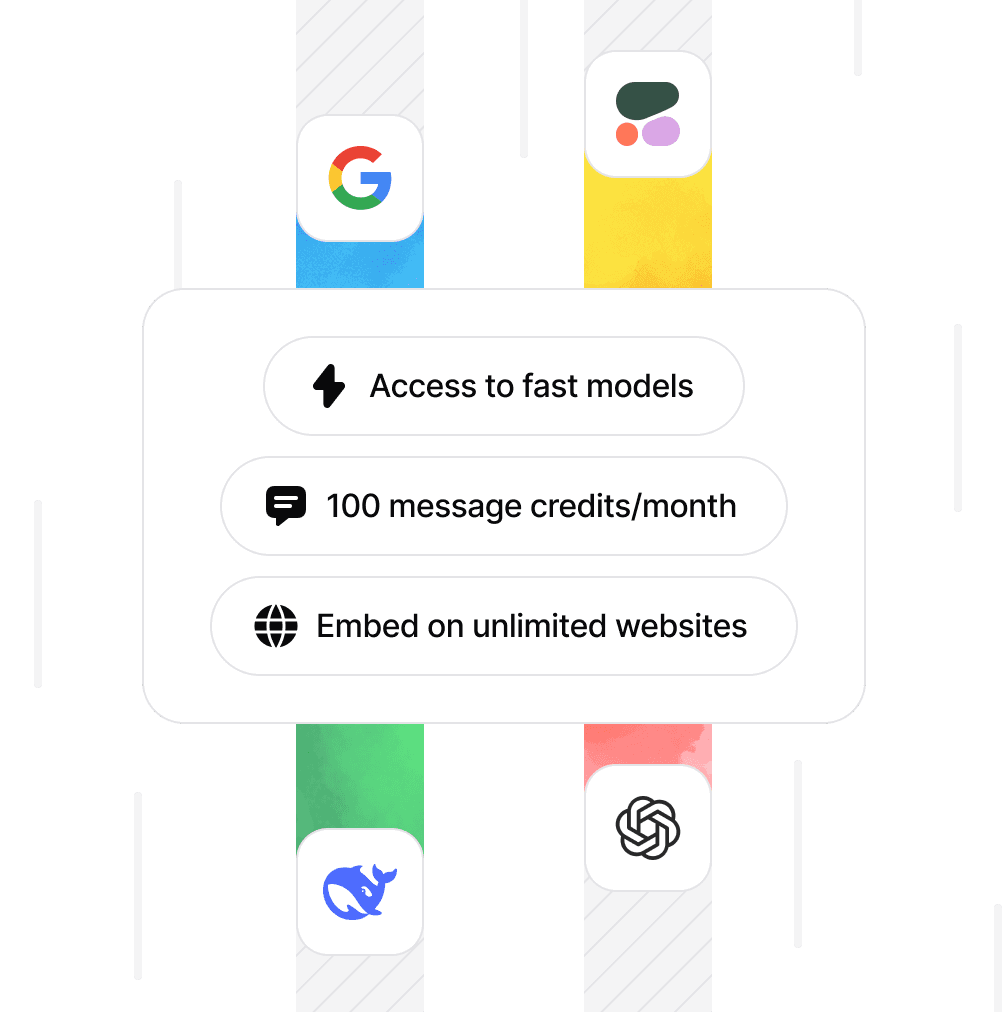
Chatbase is an AI agent builder platform that lets you create a custom chatbot trained on your own data and deploy it anywhere, on your website, WhatsApp, Slack, or through an API. It supports a wide range of leading AI models from providers including OpenAI, Anthropic, Google Gemini, DeepSeek, and Meta, so you can choose the best model for your use case.
With Chatbase, you can:
- Train on your own data. Upload documents, crawl your website, connect Notion, or manually add Q&A pairs to build a chatbot that actually knows your business.
- Define your chatbot's personality. Set the tone, style, and behavior to match your brand, whether that's professional, friendly, or somewhere in between.
- Deploy anywhere. Embed on your website, connect to WhatsApp or Slack, or integrate through the API. Your chatbot goes where your customers are.
- Customize the experience. Control topic handling, set up lead capture, configure escalation to human agents, and more.
- Get started for free. Chatbase offers a free plan so you can build and test your first chatbot without any commitment.
Go beyond off-the-shelf chatbots and create an AI agent that's built specifically for your business. Get started with Chatbase today.
Share this article:


![Ecommerce Chatbot Case Study: 3x Revenue in 6 Months [2026]](/_next/image?url=https%3A%2F%2Fcdn.sanity.io%2Fimages%2Fi6kpkyc7%2Fprod-dataset%2F4d3038da56981e704a17a8188fa078ba6e81dc4f-2046x1150.png&w=3840&q=75)