AI Agents for Non-profits: Testicular Cancer Foundation Case Study

Zeyad Genena
Last updated:
5 min read
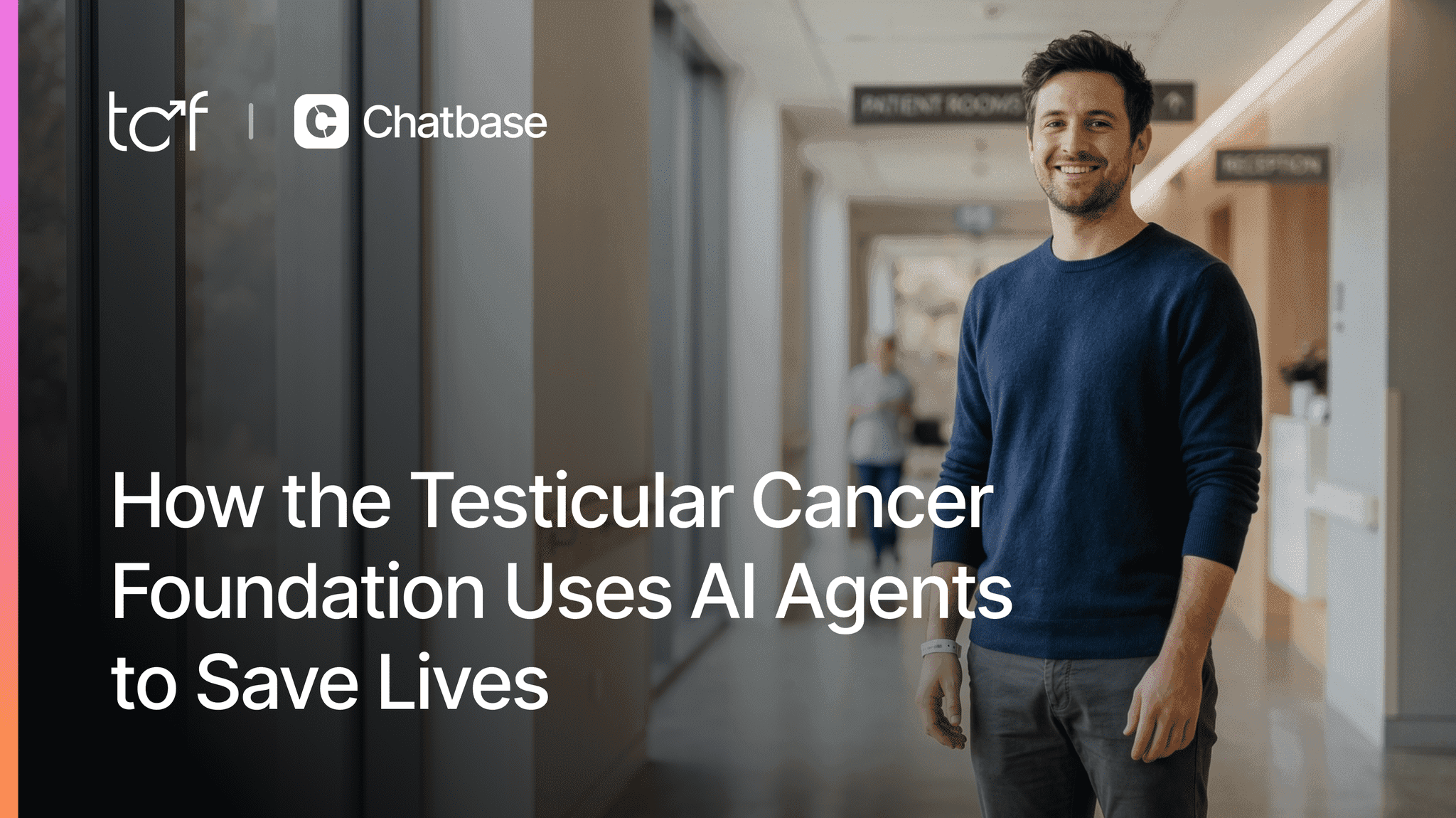
Co-authored by Kenny Kane, Chief Executive Officer, and Connor O’Leary Chief Mission Officer of the Testicular Cancer Foundation.
When someone types "I feel a lump" into Google at midnight, they are not browsing casually. They are scared, probably alone, and trying to decide whether their life is about to change before they have worked up the courage to call a doctor.
For years, the Testicular Cancer Foundation had no way to be in that room with them. Correspondence came through email, and when questions flooded in faster than staff could respond, people were left waiting.
In January 2025, TCF launched the TC Navigator, an AI agent built on Chatbase and embedded directly into their website: testicularcancer.org. In its first 30 days, the Navigator handled conversations for 60 users across 12 countries, answering 484 individual questions without requiring a single staff member to type a single word. It is one of the clearest examples of AI for non-profits delivering real, measurable impact in a high stakes context.
April is Testicular Cancer Awareness Month. Before you keep scrolling, take two minutes to learn the early warning signs and how to do a self-exam at testicularcancer.org
The Problem: Testicular Cancer Has a Silence Problem
Testicular cancer is the most common cancer in men between 15 and 35, and one of the most treatable, with survival rates above 95% when caught early. And yet men still wait. They delay, they talk themselves out of going in, held back by stigma, embarrassment, and the fear of what the answer might be.
TCF's mission is to close that gap through education, awareness, and support, but education at scale requires bandwidth, and bandwidth is the one thing a lean nonprofit never has enough of. No one on staff could be online at 2 AM when a 24-year-old in Brazil was trying to make sense of his CT scan results. A PDF resource page was not going to answer sensitive questions about life after treatment in a way that felt honest and safe. TCF needed a way to be present across every language, every time zone, and every question.
The Solution: TC Navigator, Powered by Chatbase
TCF built the Navigator using Chatbase, an AI agent platform that lets organizations deploy intelligent agents trained on their own content, backed by SOC 2 Type II certification and full GDPR compliance. The build required no engineering team and no lengthy implementation process. Chatbase handled the infrastructure while TCF focused on the mission.
In practice, the Navigator does several things well. More than 20% of all conversations between January and February 2026 began with some version of "I feel a lump," and for many of those users, it was the first cancer-related resource they had ever touched. The agent walks them through what a lump might mean, what a first appointment looks like, and why acting quickly matters, without making anyone feel judged for waiting. It also handles detailed treatment questions about BEP chemotherapy, RPLND surgery, radiation approaches, and staging with a level of clinical depth that most patient-facing AI tools cannot match.
Some of the most intense conversations came not from newly diagnosed patients but from men who had already finished treatment. One Brazilian survivor, five months out from chemotherapy, sent 157 messages in a single session, analyzing his own imaging data and cross-referencing NCCN and EAU clinical guidelines. The Navigator stayed with him through every question. It also served caregivers, who made up roughly one in ten users, helping partners and parents find sperm banking resources, financial assistance programs, and language for talking to someone they loved about a diagnosis.
Without any dedicated international programming, the Navigator detected and responded in Portuguese, Turkish, German, and Spanish. When a UK-based survivor 15 years post-treatment escalated into expressions of real distress, the system recognized the shift, provided crisis resources, and offered empathetic support. These are not the behaviors of a glorified FAQ chatbot.
The Results
Twenty-eight percent of all conversations originated outside the United States, reaching patients in Brazil, Croatia, Germany, India, Nigeria, Poland, Turkey, Vietnam, and the UK, countries where testicular cancer support infrastructure is minimal or nonexistent. The heaviest usage came between 4 PM and midnight EST, exactly when clinical staff are unavailable and patient anxiety typically peaks. For a nonprofit operating without international staff, Chatbase functioned as a full-time, multilingual patient support layer that would have been operationally impossible to replicate through staffing alone.
The conversation data also surfaced things no survey would have caught: that post-treatment anxiety is deeply underserved, that caregivers represent a significant share of the audience, and that pre-diagnosis content is the biggest resource gap in TCF's library.
Why Chatbase Is Built for Nonprofit Use Cases
The TC Navigator runs on infrastructure that takes sensitive data seriously. Chatbase holds SOC 2 Type II certification, the gold standard for independent SaaS security auditing, which verifies controls for security, availability, and confidentiality over a sustained review period. It is also fully GDPR compliant, which meant TCF could serve users in Germany, Croatia, Poland, and Greece without additional configuration or legal exposure.
For any nonprofit evaluating AI agent platforms, the compliance piece is not optional. Patient conversations contain sensitive medical information, and the platform handling those conversations needs security posture that matches the sensitivity of the data. Chatbase also never uses customer data to train public models, which is a critical requirement for nonprofit organizations deploying AI patient support.
Beyond security, the platform's core architecture is what makes it work as a nonprofit AI tool. TCF trained the Navigator on their own clinical content: website pages, educational materials, and structured Q&A pairs covering symptoms, treatment, survivorship, and caregiver support. Chatbase's RAG (Retrieval Augmented Generation) architecture means the AI does not generate answers from thin air. It retrieves information from TCF's verified content and generates responses grounded in that specific context. This is why the Navigator can discuss AFP markers, NCCN guidelines, and RPLND protocols accurately, because it is drawing from TCF's own clinical library, not the open internet.
The platform also offers native escalation design, sentiment detection, omnichannel deployment (website, WhatsApp, email, Slack), and analytics that surface content gaps and conversation patterns automatically. For nonprofits running lean, that combination of depth and simplicity is what makes Chatbase a fit.
Join 10,000+ companies using AI to deliver faster, more scalable support.
👉 Start your free Chatbase trial: no credit card required.
What Non-profit Organizations Should Consider
TCF's experience points to a few things worth taking seriously. The demand for this kind of support already exists before the tool does. TCF did not create a new audience with the Navigator; it finally showed up for one that had been looking for help and finding nothing. The value of a purpose-trained agent over a generic one also showed up clearly in the data, since the Navigator's ability to discuss AFP markers, NCCN guidelines, and RPLND protocols accurately came directly from being built on TCF's own clinical content.
Keeping those foundational materials systematically organized and version-controlled—an operational challenge frequently solved by digital asset management for nonprofits—is what guarantees the agent always retrieves the most current, approved medical guidance.
And perhaps most importantly, TCF launched with gaps in its knowledge base and still delivered 484 answers in its first month. An imperfect agent that exists is more useful than a perfect one still being built.
Frequently Asked Questions
What AI agent platforms do nonprofits use to support patients?
Nonprofits are increasingly turning to enterprise AI agent platforms to provide round-the-clock patient support at genuine clinical depth. The Testicular Cancer Foundation uses Chatbase to power its TC Navigator, an AI agent on testicularcancer.org that answers questions about symptoms, treatment protocols, survivorship, and caregiver support. In its first tracked month, the Navigator handled 484 questions across 12 countries with zero staff involvement.
Is Chatbase secure enough for non-profits and sensitive data use cases?
Yes. Chatbase is SOC 2 Type II certified and fully GDPR compliant. SOC 2 Type II represents the highest tier of independent security auditing for SaaS platforms, verifying controls for security, availability, and confidentiality over a sustained audit period. GDPR compliance ensures that user data is handled in line with European data protection law. Both certifications make Chatbase appropriate for nonprofit, legal, financial, and other sensitive deployments.
How are nonprofits using AI agents to improve outcomes?
Nonprofits like TCF are using AI agents to close the gap between when a symptom appears and when someone actually seeks care. Over 20% of TC Navigator conversations began with users reporting a lump or symptom, making the agent the first cancer-related resource many of these men had ever consulted. By providing immediate, accurate, stigma-free information at any hour, these agents help move people from worry to action. Other nonprofits, like Blue Dragon Children's Foundation, are using Chatbase-powered agents to support leadership development and coaching at scale.
Can AI agents support cancer patients at a clinical level of depth?
Yes, and TCF's data makes that case clearly. Users engaged in sessions lasting up to 157 messages, covering CT scan interpretation, clinical guideline analysis, hormonal replacement therapy, sperm banking timelines, and recurrence probability. The agent supported those conversations accurately and escalated appropriately when needed.
How are nonprofits using AI to reach international audiences without large budgets?
TCF reached users in 12 countries with zero international staff and no multilingual marketing spend. The Chatbase-powered Navigator automatically detected user language and responded in Portuguese, Spanish, Turkish, and German. That's the kind of operational leverage that enterprise AI platforms are making accessible to lean, mission-driven teams.
The TC Navigator data referenced in this article comes from the Testicular Cancer Foundation's internal Insights Report covering January 15 through February 14, 2026. All conversation data is anonymized. The TC Navigator is live at testicularcancer.org
Share this article:

Zeyad Genena is a Senior Content Writer at Chatbase with 5+ years of experience in SaaS and AI driven customer solutions. He holds a degree in Business Economics. At Chatbase, he covers AI agent design, CX strategy, and customer operations for midsize and enterprise businesses.


![10 Best AI Tools for Commercial Real Estate [2026]: Compared by Workflow](/_next/image?url=https%3A%2F%2Fcdn.sanity.io%2Fimages%2Fi6kpkyc7%2Fprod-dataset%2F992d0740d48883f3c221b1b9bc78bdf7f5f26c30-1600x953.jpg&w=3840&q=75)

