15 Lead Generation Strategies & Tactics That Work in 2026

Ilias Ism
Jan 20, 2026
21 min read
Most lead generation advice is garbage. "Post on social media" and "create valuable content" aren't strategies. They're vague suggestions that help no one.
Here's the reality: lead generation is simple in concept, brutal in execution. You identify people who might buy what you sell, get their contact information, and nurture them toward a purchase. The hard part is doing it consistently, at scale, without burning through your budget or your sanity.
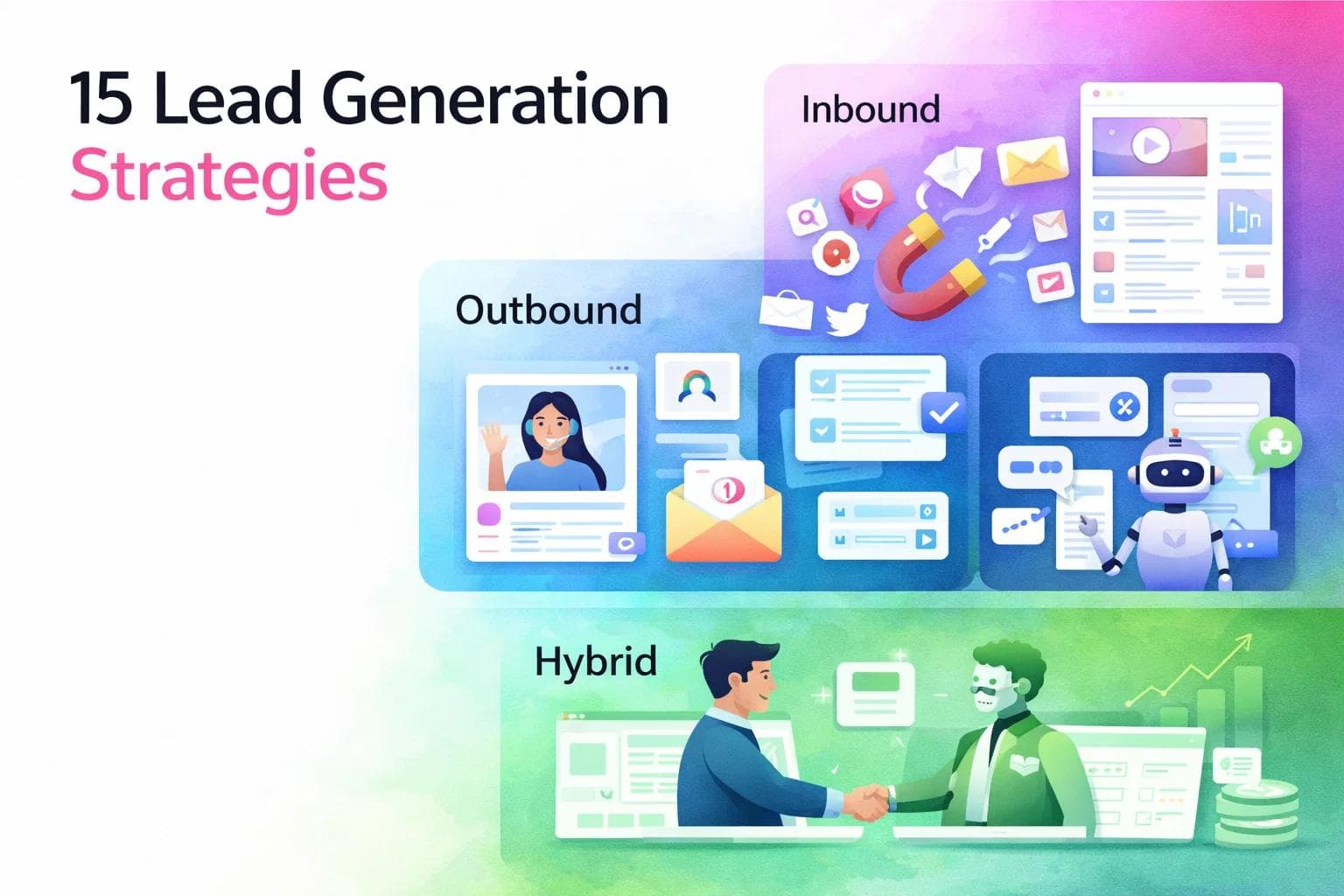
This guide covers 15 lead generation strategies that actually work. Not theory. Tactics you can implement this week, with specific approaches for each. We've organized them by type: inbound (pull prospects to you), outbound (push to them), and hybrid approaches that combine both.
Pick 2-3 that fit your business. Going wider dilutes focus. Going deeper gets results.
Inbound Lead Generation Strategies
Inbound strategies attract prospects to you. They take longer to build but compound over time and typically deliver higher-quality leads at lower cost.
1. AI Chatbots for Lead Qualification
![[object Object]](/_next/image?url=https%3A%2F%2Fcdn.sanity.io%2Fimages%2Fi6kpkyc7%2Fprod-dataset%2Fcd416f677233fd8fe815c0f92509b4f535f25d6c-1536x1024.webp&w=3840&q=75)
What it is: Deploy AI-powered chatbots on your website to engage visitors, qualify leads through conversation, and route hot prospects to sales.
Why it works: Static forms have 2-3% conversion rates. People abandon them. Chatbots start conversations, ask qualifying questions naturally, and capture information without feeling like paperwork. They work 24/7, qualifying leads at 3 AM when your sales team is asleep.
How to implement:
- Define your ideal customer criteria (budget, timeline, company size, pain points)
- Train your chatbot on your product docs, FAQs, and common objections
- Set up qualification triggers (when visitors mention "pricing" or "demo")
- Configure lead scoring based on responses
- Connect to your CRM so qualified leads flow directly to sales
With Chatbase, your AI agent understands your business context through RAG (retrieval-augmented generation). It asks strategic questions about budget, timeline, and challenges, then routes high-intent prospects to your sales team while sending educational content to earlier-stage visitors.
What you can expect: Sales teams typically save 50-70% of qualification time. You capture leads around the clock, even outside business hours when forms sit untouched. And your sales reps get full conversation context, not just names and emails.
2. Content Marketing + SEO
![[object Object]](/_next/image?url=https%3A%2F%2Fcdn.sanity.io%2Fimages%2Fi6kpkyc7%2Fprod-dataset%2F65bdd49a4672f4c09963d470fdd4e92ce581aedb-1536x1024.png&w=3840&q=75)
What it is: Create content that solves problems your target audience searches for. Rank organically on Google. Capture leads through gated resources or CTAs.
Why it works: Content marketing generates 3x more leads than paid search at roughly half the cost. And once you rank, traffic is essentially free, forever! Plus, people searching for solutions are already in buying mode.
How to implement:
- Research keywords your audience actually uses (tools like Ahrefs or Semrush)
- Create comprehensive content that answers their questions better than competitors
- Gate high-value resources (templates, calculators, guides) behind email capture
- Add clear CTAs throughout your content
- Build internal links between related posts
Start here: Create comparison pages ("Your Product vs. Competitor"). These target bottom-of-funnel searchers who are ready to buy and just need to decide between options.
3. Lead Magnets + Landing Pages
![[object Object]](/_next/image?url=https%3A%2F%2Fcdn.sanity.io%2Fimages%2Fi6kpkyc7%2Fprod-dataset%2F99f2d5c61df599cba36d403ce57d61a3a9001cb2-1536x1024.png&w=3840&q=75)
What it is: Offer something valuable (ebook, template, checklist, calculator) in exchange for contact information. Drive traffic via ads, social, or SEO.
Why it works: People won't give you their email for nothing. But they'll trade it for something that solves an immediate problem. For most of my lead magnets, they have 10-20% conversion rates, on average, depending on the niche and market.
How to implement:
- Identify a specific pain point your audience has
- Create a resource that provides quick wins (not your entire course)
- Build a focused landing page with one CTA
- A/B test headlines, copy, and form fields
- Set up email sequences to nurture leads after download
Pro tip: The best lead magnets provide immediate value. Templates they can use today beat 50-page ebooks they'll never read. For example, I offer a free SEO checklist (in Notion) on my blog.
But for B2B, what often works is some type of customer case study, or webinar (more on that below).
4. Webinars and Virtual Events
![[object Object]](/_next/image?url=https%3A%2F%2Fcdn.sanity.io%2Fimages%2Fi6kpkyc7%2Fprod-dataset%2F6a9db564947ce4337734c87205a9a012212d0c8d-2086x1148.jpg&w=3840&q=75)
What it is: Host free educational sessions on topics your audience cares about. Capture registrations, deliver value, and convert attendees.
Why it works: Webinar attendees self-qualify as interested. They're investing time to learn from you. Conversion rates hit 20-30% for well-executed webinars because you build trust through demonstrated expertise.
How to implement:
- Pick a topic that addresses a specific pain point
- Promote via email, social, and paid ads
- Deliver genuine value (not a 45-minute sales pitch)
- Include Q&A to engage attendees
- Follow up within 24 hours while interest is high
What to avoid: Don't make your webinar a product demo disguised as education. People can tell, and they'll leave. Use the "Perfect Webinar Presentation" formula by Russell Brunson, the creator of Clickfunnels, it really sells well, and is focused on conversion rate optimization, I highly recommend it!.
5. Social Media Organic Growth
![[object Object]](/_next/image?url=https%3A%2F%2Fcdn.sanity.io%2Fimages%2Fi6kpkyc7%2Fprod-dataset%2F291bc0ab5748631b76cce9ce63c9df35d6f34b7a-1294x1206.jpg&w=3840&q=75)
What it is: Build an audience on platforms where your prospects spend time. Share valuable content consistently, engage authentically, and convert followers into leads.
Why it works: Social algorithms reward consistency. 2-5 posts per week builds audience over time. People trust people, not brands! When you (or your team) share genuine insights, followers become leads.
Platform selection:
- LinkedIn: B2B gold. Decision-makers are active here. Example: Chatbase
- X (Twitter): Tech, SaaS, and startup audiences, for example: Yasser (Chatbase CEO)
- Instagram/TikTok: B2C, visual products, younger demographics
- YouTube: Long-form education, builds deep trust. Eg: Chatbase on YouTube
How to implement:
- Post valuable content 3-5x per week minimum
- Engage with your audience's content (don't just broadcast)
- Use DMs strategically for warm outreach
- Include clear CTAs in posts and profile
Reality check: Social takes time. Expect 3-6 months before meaningful traction. But the compounding effect is real, almost all the leads and good sales come from social media for most fresh startups.
6. Video Marketing
What it is: Create video content that educates, entertains, or inspires your target audience. Distribute on YouTube, social platforms, and your website.
Why it works: YouTube has 2.5 billion monthly active users. It's not just a video platform; it's a search engine. If you're not there, you're missing a massive slice of potential leads.
How to implement:
- Start with educational content answering common questions
- Optimize titles and descriptions for search
- Include CTAs within videos (not just descriptions)
- Repurpose long-form into short clips for social
- Don't wait for perfect equipment. Phone quality is fine!
Pro tip: Authenticity beats production value in B2B. A helpful video shot on your phone outperforms a polished corporate video that says nothing. But you want to provide deep value, people appreciate it and you will build massive trust.
Outbound Lead Generation Strategies
Outbound is direct. You reach out to prospects rather than waiting for them to find you. Higher rejection rates, but faster results when done right.
7. Warm Outreach
![[object Object]](/_next/image?url=https%3A%2F%2Fcdn.sanity.io%2Fimages%2Fi6kpkyc7%2Fprod-dataset%2Fe793bd75b4913bd3805c7d681515f633dcdee6db-1536x1024.png&w=3840&q=75)
What it is: Reach out to people who already know you: existing contacts, LinkedIn connections, past customers, or referrals from your network.
Why it works: There's gold in your phone. Your Instagram followers. Your LinkedIn connections. These people already have context on who you are, which dramatically increases response rates.
How to implement:
- Export your contacts from email, LinkedIn, and phone
- Identify who might need what you sell (or know someone who does)
- Reach out with a personalized message (not a pitch)
- Ask how you can help, not whether they want to buy
- Ask for referrals even if they're not a fit
The script:
- Introduction (how's life? what's new?)
- Transition ("Quick question for you...")
- The ask ("Do you know anyone who's struggling with [problem]?")
- The offer ("I'm helping a few people with [solution] in exchange for honest feedback")
- The referral request ("Would you be open to introducing me?")
Pro tip: Offer something valuable first. Free trial, discount, consultation. The rule of reciprocity means people feel obligated to help after you've helped them.
8. Cold Outreach (Email + LinkedIn)
![[object Object]](/_next/image?url=https%3A%2F%2Fcdn.sanity.io%2Fimages%2Fi6kpkyc7%2Fprod-dataset%2F6a151abead85291b29eb9fc5305e51b4552fc50b-1536x1024.png&w=3840&q=75)
What it is: Contact prospects who don't know you via email, LinkedIn messages, or other direct channels.
Why it works: Cold outreach works when you combine volume, personalization, and genuine value. Send 100 emails per day at 5% response rate and you get 5 conversations. Scale that and you have a pipeline.
How to implement:
- Build a targeted list (use tools like Apollo, Hunter, LinkDR, or Sales Navigator)
- Research each prospect enough to personalize
- Lead with value, not a pitch
- Follow up 4-7 times (most deals close after the 5th touch)
- Track everything in a CRM
The formula:
- Personalized opening (reference something specific about them)
- Problem statement (acknowledge a pain they likely have)
- Value proposition (how you solve it, with proof)
- Soft CTA (offer something free, not "let's book a call")
What doesn't work: Generic templates, immediate asks, no follow-up. If your first email is "I'd love to hop on a quick call," you're doing it wrong.
9. Paid Advertising
![[object Object]](/_next/image?url=https%3A%2F%2Fcdn.sanity.io%2Fimages%2Fi6kpkyc7%2Fprod-dataset%2Fb0b62d3f77cd694b567b854a85ddaee4aff6d55d-1536x1024.png&w=3840&q=75)
What it is: Run targeted ads on Google, LinkedIn, Meta, or other platforms to drive traffic to landing pages or lead magnets.
Why it works: Speed and scale. You can target your ideal customer with precision, test messaging quickly, and generate leads while your organic strategies ramp up.
Platform selection:
- Google Ads: Intent-based. People actively searching for solutions.
- LinkedIn Ads: B2B targeting by job title, company size, industry.
- Meta (Facebook/Instagram): Broad reach, lower cost, but less B2B intent.
How to implement:
- Define your target audience precisely
- Create compelling ad creative with clear value prop
- Build focused landing pages (one CTA per page)
- Start with small budget ($500-1K) to test
- Optimize based on cost per lead, not impressions
Warning: Ad costs rose 15% year-over-year.
![[object Object]](/_next/image?url=https%3A%2F%2Fcdn.sanity.io%2Fimages%2Fi6kpkyc7%2Fprod-dataset%2Ff2b09dee9e00f4fe5325084eab9d65ef004052ad-2340x990.jpg&w=3840&q=75)
Target CPL under $50 for B2B, under $20 for B2C. Kill underperforming campaigns fast.
10. Retargeting and Remarketing
![[object Object]](/_next/image?url=https%3A%2F%2Fcdn.sanity.io%2Fimages%2Fi6kpkyc7%2Fprod-dataset%2F1df903e6ce785c6939dec5f53edd0ca9efcfda8e-1536x1024.png&w=3840&q=75)
What it is: Show ads to people who've already visited your website or engaged with your content. They're warmer than cold audiences.
Why it works: Only 2-3% of visitors convert on first visit. Retargeting keeps you top of mind for the other 97%. These people already know you, which means higher conversion rates and lower ad costs.
How to implement:
- Install tracking pixels on your website (Google, Meta, LinkedIn)
- Create audience segments based on behavior (visited pricing page, downloaded lead magnet)
- Serve relevant ads based on where they dropped off
- Use lookalike audiences to find similar prospects
Pro tip: Create different messages for different stages. Someone who visited your pricing page needs a different ad than someone who read a blog post.
Hybrid Strategies
These combine elements of both inbound and outbound, often using automation to scale human effort.
11. Email Marketing Automation
![[object Object]](/_next/image?url=https%3A%2F%2Fcdn.sanity.io%2Fimages%2Fi6kpkyc7%2Fprod-dataset%2F52a99de82c0d8a9abefe2abb5000d25c1f3a6355-1536x1024.png&w=3840&q=75)
What it is: Build email lists through inbound methods, then nurture leads with automated sequences that deliver value and move them toward purchase.
Why it works: Email marketing has 40x ROI when done right. The key is segmentation and relevance. Generic blasts get ignored. Personalized sequences convert.
How to implement:
- Capture emails via lead magnets, content upgrades, or website signups
- Segment by behavior, interest, or stage in buying journey
- Create automated sequences: welcome series, educational content, product-focused
- Personalize with dynamic content (name, company, past behavior)
- Test subject lines, send times, and content continuously
Essential sequences:
- Welcome series: Introduce yourself, deliver promised value
- Nurture sequence: Educate on problems you solve
- Sales sequence: Make your offer with clear benefits
12. Referrals and Partnerships
![[object Object]](/_next/image?url=https%3A%2F%2Fcdn.sanity.io%2Fimages%2Fi6kpkyc7%2Fprod-dataset%2F29f00e2a39176f647080015f90ea9794c7690abb-1536x1024.png&w=3840&q=75)
What it is: Get existing customers and partners to introduce you to prospects. Warm leads who come pre-sold on your credibility.
Why it works: 59% of buyers trust peer recommendations over company marketing. Referrals convert 4x better than cold leads because they come with built-in trust.
How to implement:
- Ask happy customers for introductions (simple, but most people don't do this)
- Create a formal referral program with incentives
- Partner with complementary businesses who serve the same audience
- Build relationships with industry influencers
The ask: "Who do you know who's also struggling with [problem you solve]? I'd love an intro if you think they'd be open to it."
Pro tip: Time your ask after delivering a win. Right after you solve a big problem is when customers are most willing to refer.
13. Reviews and Social Proof
![[object Object]](/_next/image?url=https%3A%2F%2Fcdn.sanity.io%2Fimages%2Fi6kpkyc7%2Fprod-dataset%2F031ca170b135733860a357601785923f0efd33d4-1536x1024.png&w=3840&q=75)
What it is: Systematically collect and leverage customer reviews, testimonials, and case studies to build credibility and convert leads.
Why it works: The highest percentage of sales across any market come from word of mouth. Reviews are the digital version of word of mouth. Display them everywhere prospects might see them.
How to implement:
- Ask for reviews after every successful outcome
- Make it easy (send direct links to review platforms)
- Feature testimonials prominently on your website
- Create case studies from your best success stories
- Use review content in ads, emails, and sales conversations
Where to display:
- Website (homepage, pricing page, landing pages)
- Sales decks and proposals
- Email signatures and sequences
- Social media posts
- Ad creative
Alex Hormozi's approach: Create a self-reinforcing system. Get customers, deliver results, ask for reviews, use those reviews to get more customers. The more proof you stack, the easier each subsequent sale becomes.
14. AI-Powered Tools and Automation
![[object Object]](/_next/image?url=https%3A%2F%2Fcdn.sanity.io%2Fimages%2Fi6kpkyc7%2Fprod-dataset%2Fa13be9cfcc9b5c6f6c758edfde05bc785c3036d7-2582x1548.jpg&w=3840&q=75)
What it is: Use AI to automate and scale lead generation tasks: chatbots for qualification, predictive scoring, personalized outreach, and more.
Why it works: AI handles repetitive tasks at scale without burning out. Chatbots qualify leads 24/7. AI writing tools personalize outreach at volume. Predictive scoring helps you focus on the hottest prospects.
Key applications:
- Lead qualification chatbots: Engage visitors, ask qualifying questions, route to sales
- Intent data: Identify companies researching topics you solve
- AI outreach personalization: Generate customized messages at scale
- Predictive lead scoring: Prioritize leads most likely to convert
Chatbase handles lead qualification automatically. Your AI agent engages visitors in natural conversations, asks strategic questions about their needs, scores responses using sentiment analysis, and routes qualified leads directly to your sales team with full context.
15. Interactive Content and Gamification
![[object Object]](/_next/image?url=https%3A%2F%2Fcdn.sanity.io%2Fimages%2Fi6kpkyc7%2Fprod-dataset%2Fd7e4971a1f7e7d8ebf69bb6f0fd296d0ea848818-1536x1024.png&w=3840&q=75)
What it is: Create quizzes, calculators, assessments, or interactive tools that engage prospects while capturing lead information.
Why it works: Interactive content gets 2x more engagement than static content. People enjoy participating. And you capture lead information as a natural part of the experience, not a separate ask.
Examples:
- ROI calculators: Show prospects the value they'd get from your solution
- Assessment quizzes: "What type of [X] is right for your business?"
- Product matching tools: Help prospects find the right offering
- Spin-to-win: Gamified lead capture for promotions
How to implement:
- Identify a question prospects commonly ask
- Build an interactive tool that answers it
- Require email to see results (but deliver value first)
- Follow up with personalized recommendations
Pro tip: Let people engage first, then ask for information. A quiz that requires email upfront converts worse than one that asks after you've invested time.
How to Choose Your Lead Generation Strategy
![[object Object]](/_next/image?url=https%3A%2F%2Fcdn.sanity.io%2Fimages%2Fi6kpkyc7%2Fprod-dataset%2F118f2ebba5a97b67f8f54743beb31f3fe50ea0a5-1536x1024.png&w=3840&q=75)
Not every strategy fits every business. Here's how to decide:
- AI Chatbots: Best for any website with traffic. Immediate results. Low-medium cost.
- Content + SEO: Best for long-term growth. 3-6 months to results. Low cost.
- Lead Magnets: Best for quick list building. 1-2 weeks to results. Low cost.
- Webinars: Best for B2B, complex products. 2-4 weeks to results. Low-medium cost.
- Social Organic: Best for brand building. 3-6 months to results. Low cost.
- Video Marketing: Best for education-focused businesses. 3-6 months to results. Low-medium cost.
- Warm Outreach: Best for new businesses, quick wins. Immediate results. Free.
- Cold Outreach: Best for B2B sales teams. 2-4 weeks to results. Low-medium cost.
- Paid Ads: Best for fast results with budget available. Immediate results. High cost.
- Retargeting: Best for existing website traffic. 1-2 weeks to results. Medium cost.
- Email Automation: Best for existing leads. 2-4 weeks to results. Low cost.
- Referrals: Best for happy customers. Ongoing results. Free.
- Reviews/Social Proof: Best for conversion optimization. Ongoing results. Free.
- AI Automation: Best for scaling operations. 1-2 weeks to results. Medium cost.
- Interactive Content: Best for engagement, differentiation. 2-4 weeks to results. Medium cost.
For immediate results: Start with warm outreach, AI chatbots, and paid ads. These generate leads fast while you build longer-term strategies.
For sustainable growth: Invest in content marketing, SEO, and email automation. These take time but compound.
For maximum efficiency: Use AI tools to qualify leads automatically, personalize outreach at scale, and free your team for high-value conversations.
Measurement and Optimization
You can't improve what you don't measure. Track these metrics:
- Cost per lead: How much does each lead cost to acquire?
- Lead-to-customer conversion rate: What percentage of leads become customers?
- Time to conversion: How long from first touch to purchase?
- Lead quality score: Are leads actually qualified?
- ROI by channel: Which strategies deliver the best return?
Review weekly: Which channels are working? Which are wasting money? Double down on winners. Kill losers fast.
Get Started with AI-Powered Lead Generation
If you're getting website traffic but not capturing leads, you have a conversion problem, not a traffic problem.
Chatbase turns your website into a lead generation machine. Your AI agent engages visitors in natural conversations, qualifies them based on your criteria, and routes hot prospects directly to your sales team, all while you sleep.
No more forms that visitors abandon. No more leads that slip through the cracks. Just qualified conversations that turn into customers.
Try Chatbase free and see how AI-powered lead qualification works for your business.
Related resources:
Share this article: